A well-packed Bunnings 150L box arrives in Nairobi, Dar es Salaam or Kampala looking much the way it left Perth. A badly packed one arrives crushed, rattling or held up at customs. The difference is about an hour of care, and this guide walks you through it.
Most of the cargo we send to East Africa travels in these boxes. They are strong, a standard size, and easy to stack in a container, which is why shipping one with BenCal starts at $220. If you do not have any, we supply them. Here is how to fill one properly.
Start with the right box
Use a Bunnings 150L heavy duty box, not a supermarket carton or a box that has already done a house move. A tired box loses its strength at the corners, and corners take the weight when boxes are stacked several high in a container for weeks.
- Check it is clean, dry and undamaged. A damp patch or a split seam will get worse at sea.
- Assemble it fully and tape the bottom before you put anything in it.
- Need boxes? Ask for them when you request your quote. We supply Bunnings 150L heavy duty boxes to customers who do not have their own.
How to tape the box so it holds
Use wide packing tape, not masking tape or sticky tape. Tape the bottom in an H pattern: one strip along the centre seam, then one across each edge. Do the same on top once the box is full. Run an extra strip around the bottom edges if the box is heavy.
What goes in first
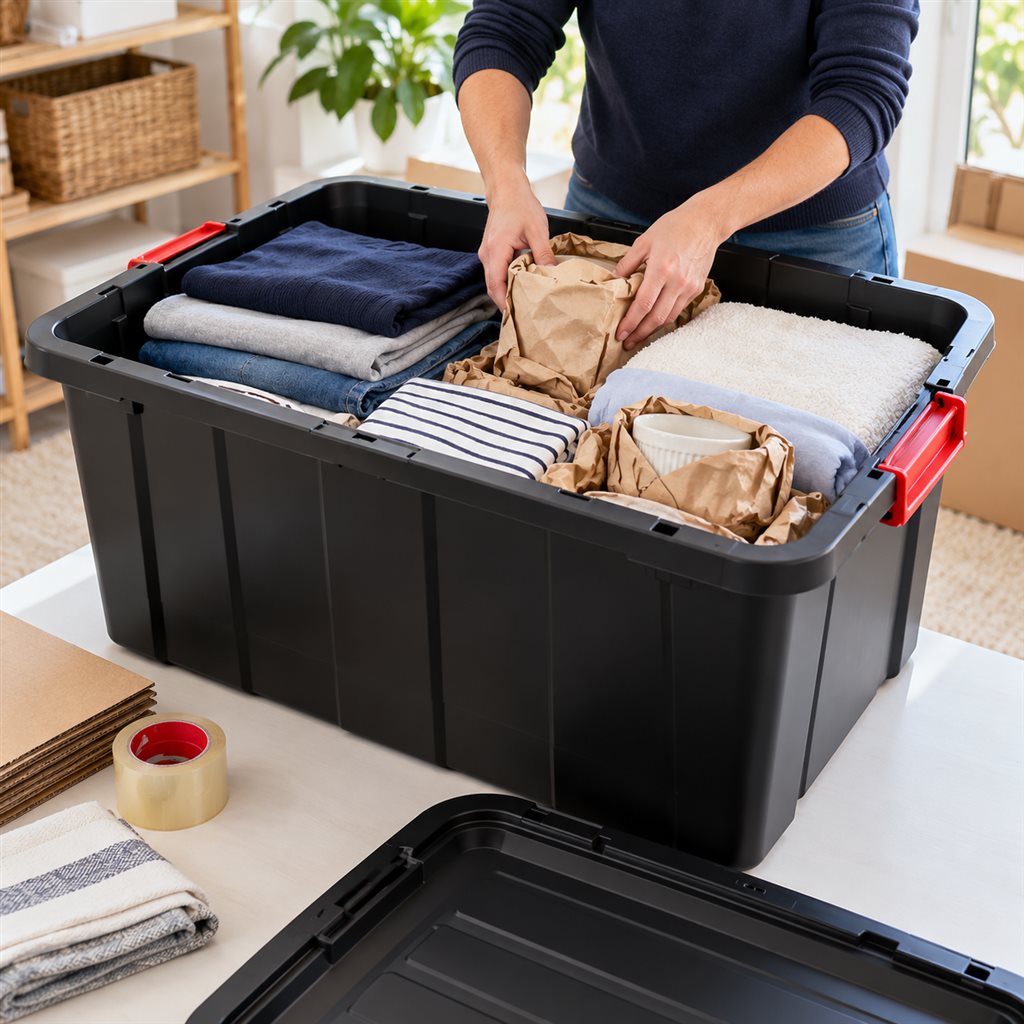
Pack in layers, heaviest at the bottom and lightest at the top.
- Bottom layer: heavy and solid. Pots, pans, tools, tinned or boxed goods that are allowed to travel, shoes in pairs.
- Middle layer: medium weight. Small appliances in their own boxes if you still have them, books, folded jeans and jackets.
- Top layer: light and soft. Clothes, bedding, towels and cushions. They also act as padding for everything below.
Fill every gap. A box with empty space inside will cave in when another box is stacked on top of it, and items that can move will break each other. Use towels, clothes, bedding or crumpled paper to fill corners and the space between items.
Do not wrap anything in plastic carrier bags if it is going to Kenya or Tanzania. Both countries ban plastic carrier bags, Tanzania's ban covers bags of any thickness, and Kenya and Uganda also prohibit thin plastics under 30 microns. Use paper, cloth, cardboard or the clothes you are already sending, and ask us before using any other plastic packing.
How to protect fragile items
- Wrap glass and ceramics individually in paper or cloth, then pack them upright in the middle of the box, surrounded on every side by soft items.
- Plates travel best on their edge, like records in a rack, not stacked flat.
- Electronics go in their original box where possible, or wrapped in a towel with padding all round. If they contain lithium batteries, tell us when you book, because batteries have their own rules, especially for air freight.
- Liquids such as cooking oil or lotions should be sealed, taped at the lid and placed in a sealed container, upright, so a leak cannot soak the whole box.
Keep the weight manageable
It is tempting to fill a 150L box with books and tins. Resist it. Keep each box to a weight one or two people can lift safely, because it will be lifted by hand at several points between Perth and the destination city. If you are not sure, ask us and we will advise before you finish packing. Heavy items are better spread across several boxes than crammed into one.
Need boxes, or a price for the ones you have?
Shipping a Bunnings 150L box starts at $220, and we can supply the boxes too.
What not to pack
Some things cannot be shipped at all, and some are fine by sea but not by air. Packing a forbidden item does not just risk that item: it can hold up the whole shipment at customs. Common problems include:
- anything flammable or pressurised, such as aerosols, gas bottles, paint, lighters and fuel
- loose lithium batteries and power banks, especially for air freight
- counterfeit or copied goods
- used underwear, which East African customs do not accept
- for Uganda, used fridges, televisions and computers, which are on the Uganda Revenue Authority's prohibited list, so talk to us first
Our prohibited items guide covers the full picture. If you are unsure about anything, ask before you seal the box, not after.
Label every box clearly
A clear label is what gets your box to the correct destination. Write on two sides of the box, not just the top, in thick permanent marker or on a firmly taped label:
- the consignee's full name
- the consignee's phone number in Kenya, Tanzania or Uganda, so our team can contact them about arrival
- the destination city: Mombasa, Nairobi, Nakuru, Eldoret, Dar es Salaam or Kampala
- your name and Australian phone number
- a box number, such as "Box 2 of 5"
Mark boxes that hold fragile items, and mark which way is up. Then cover old labels or barcodes from previous use so nobody reads the wrong address.
Make a contents list and take photos
Before you seal each box, write down what is in it and roughly what it is worth, then take a photo of the open box and the closed, labelled box. Keep the list and the photos on your phone.
The list matters for three reasons. Our team uses it to prepare the paperwork for customs clearance. Customs officers at the destination may check a box against it. And if you add optional cargo insurance, a list and photos make it far easier to show what was sent. Honest descriptions and values prevent delays: a vague or understated list is one of the most common reasons boxes get held for inspection.
Getting the box to us
Once your boxes are packed, labelled and listed, you can drop them at our Canning Vale depot in Perth during business hours, or we can arrange collection from your address anywhere in Australia. Sea freight leaves Perth once a month, so ask us for the next cut-off date and plan your packing around it. From there, we clear the cargo for export, ship it and deliver it to the destination city, with updates along the way and online tracking.
If you are still deciding how to send it, our guide to choosing between sea and air freight explains the trade-off, and how long shipping to East Africa takes sets out a realistic timeline.
Import rules referenced in this guide were checked in October 2026 against NEMA Kenya, the Tanzania Revenue Authority, the Uganda Revenue Authority and IATA guidance. Rules change, so we confirm the current position for your shipment before you book.
Related reading

Sea Freight or Air Freight to East Africa
Cost, speed and what each will carry, and the simple test that decides it.
Read the guide
Shipping Furniture and Appliances to Tanzania
How to prepare sofas, fridges and washing machines for the journey.
Read the guide
Ship a Box From $220
Box shipping to Kenya, Tanzania and Uganda, delivered to the selected destination city.
See the service